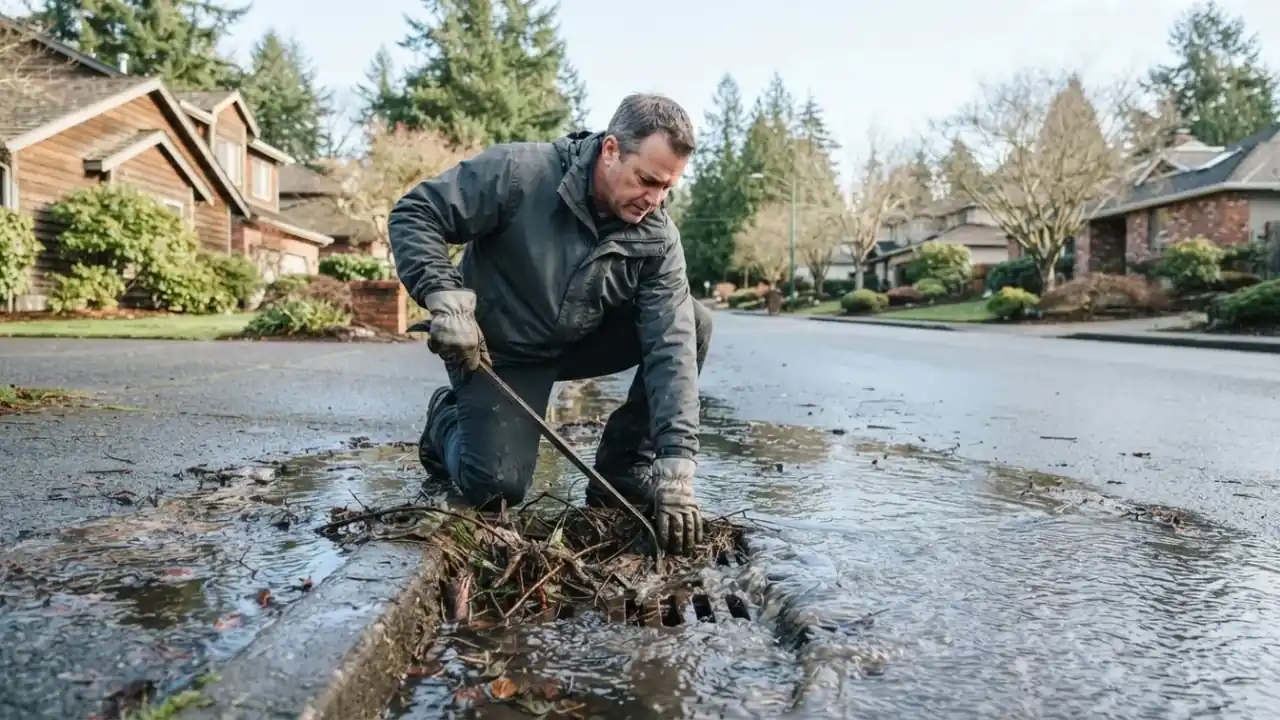
You prevent sewage backups during Bothell heavy rain season by keeping stormwater out of the sanitary sewer, keeping your side of the lateral clear, and having a plan for the 48 hours when the ground is saturated. The single highest-impact step is a backwater valve on your sewer lateral, which stops the city main from pushing sewage backward into your basement when flows spike. Everything else - from gutter maintenance to sump checks - buys you time and reduces the volume that reaches your floor drain.
Bothell sits where the Sammamish River and North Creek meet, and between October and March the region gets roughly 35 to 40 inches of rain, most of it in concentrated atmospheric river events. That is when we get the calls. This guide covers what actually causes backups here, the maintenance that prevents them, and the warning signs that mean you should stop reading and call us.
Why Bothell's heavy rain season causes sewage backups
Bothell's heavy rain season causes sewage backups because the ground cannot absorb water fast enough, so stormwater infiltrates cracked sewer laterals and overwhelms the city main. When the main surcharges, the lowest connection on the block - often a basement floor drain or a laundry standpipe - becomes the relief valve. That is a plumbing problem, not a weather problem, and it is fixable.
The city's combined storm and sanitary infrastructure in older neighborhoods like sewage backup cleanup in Downtown Bothell was built before the 1970s, when rainfall patterns were less intense. A 2026 update to the Bothell surface water management plan notes that peak flows in North Creek now exceed the 100-year design storm in some reaches. Translation: the pipes were sized for a storm that happens less often than it used to.
Three conditions line up to cause most backups we see:
- Saturated soil - after 3 to 4 inches of rain in 24 hours, the water table rises above the lateral pipe, and every crack and root intrusion becomes an inlet.
- Blocked laterals - grease, wipes, and tree roots narrow the pipe, so it takes less inflow to back up.
- City main surcharge - when the main fills, hydrostatic pressure pushes sewage toward the lowest open connection.
We have pulled roots the diameter of a garden hose out of laterals in sewage backup cleanup in Canyon Park, where mature Douglas firs and maples sit within 10 feet of the sewer line. That is a preventable problem.
What causes sewage backups during heavy rain in Bothell WA
During heavy rain in Bothell WA, sewage backups are caused by four things: inflow and infiltration into the lateral, root or grease blockages, a failed or missing backwater valve, and sump pump discharge plumbed into the sanitary sewer. Fix any one of those and you cut your risk substantially. Fix all four and you can ride out a Pineapple Express without a shop vac.
Inflow and infiltration
Inflow is direct connection - a downspout, yard drain, or foundation drain tied into the sanitary line. Infiltration is groundwater seeping through cracks, joints, and manhole covers. Both add volume the pipe was not designed to carry. Bothell code prohibits downspouts and foundation drains from discharging into the sanitary sewer, but plenty of older homes still have them connected.
Root intrusion and grease
Roots enter at joints, and grease coats the pipe above the flow line. Neither blocks the pipe completely on a dry day. Add rain, and the reduced diameter cannot handle the surge. A lateral that flows fine in August can back up in November.
Failed backwater valves
A backwater valve is a flapper that lets sewage out but not back in. They fail when debris jams the flapper open or the seal dries out. If your valve is more than 10 years old and has never been serviced, assume it is not protecting you.
Sump pumps tied to the wrong line
We find sump pumps discharging into laundry standpipes or floor drains in maybe one out of six homes we inspect. During a storm, the pump runs continuously and sends hundreds of gallons per hour into a sewer that is already full. That is a direct path from your sump to your basement floor.
How can I prevent sewage backups during heavy rain in Bothell
You prevent backups by reducing what enters the sewer, keeping the lateral clear, and installing a backwater valve as a last line of defense. The order matters: a valve on a blocked lateral just traps sewage between the blockage and your floor drain. Clear the pipe first, then protect it.
Here is the sequence we recommend to homeowners across sewage backup cleanup in North Creek, where the water table sits high through winter:
- Disconnect downspouts and foundation drains from the sanitary sewer. Route them to a splash block, rain garden, or storm drain. This alone can cut inflow by 30 to 50 percent on a typical 2,000-square-foot roof.
- Camera-inspect the lateral every 2 to 3 years. A camera inspection runs $250 to $450 in 2026 and tells you whether roots, bellies, or offset joints are waiting to catch debris.
- Hydro-jet or snake the lateral if the camera shows buildup. Hydro-jetting runs $350 to $700 and removes grease and roots that a snake just pokes through.
- Install a backwater valve on the building drain. Cost is typically $1,200 to $2,800 installed, depending on access and whether the floor needs to be opened. It is the cheapest insurance you can buy against a $10,000 to $25,000 finished-basement loss.
- Service the valve annually before the rain starts. We clean and test the flapper, usually as part of a fall maintenance visit.
If you already have water in the basement, stop reading and call us for emergency sewage removal bothell WA. Sewage is a Category 3 water loss, and the clock on mold growth starts at 24 to 48 hours.
Pre-season maintenance checklist for Bothell homeowners
Run this checklist in late September or early October, before the first big storm. Every item is something you can do yourself or have done for a few hundred dollars. Doing it in dry weather is the whole point - you are not fighting the rain.
- Clean gutters and downspouts. Bothell's evergreens drop needles year-round. A clogged gutter sends roof water straight down the foundation.
- Extend downspouts 6 to 10 feet from the foundation. Short extensions just dump water back against the wall.
- Check the sump pump. Pour a bucket of water into the pit and confirm the float trips and the discharge line is clear. Replace the pump every 7 to 10 years.
- Test the backwater valve. Lift the access cover and confirm the flapper moves freely. If it is stuck, call us.
- Clear floor drains. Pour a gallon of water down each one. If it drains slowly, the trap or branch line is partially blocked.
- Look for cracks in the basement floor and walls. Groundwater finds them. Epoxy injection is a $400 to $900 fix per crack.
- Know where your main cleanout is. If we need to snake or jet the line, that is where we start.
One more: if your home was built before 1980, check whether the lateral is cast iron or Orangeburg. Orangeburg pipe - tar-paper pipe used from the 1940s to the 1970s - deforms under saturated soil and collapses. If you have it, plan to replace the lateral, not just clean it.
What to do when rain is in the forecast
When 2 or more inches of rain is forecast in 24 hours, treat it like a minor emergency. The steps below take 15 minutes and cost nothing. They will not save a lateral that is already blocked, but they reduce the load on a marginal system.
- Do not run the dishwasher, washing machine, or take long showers during the peak of the storm. Every gallon you send down the drain competes with stormwater for pipe capacity.
- If you have a sump pump, confirm the discharge is going outside, not into a floor drain or standpipe.
- Put valuables and cardboard boxes up on shelves or pallets in the basement. Sewage wicks into cardboard and ruins it in minutes.
- Keep a wet/dry shop vac, rubber gloves, and N95 masks on hand. If you get a small backup, you can start extracting while you wait for us.
- Take photos of the floor drain and any water before you touch anything. Your insurance adjuster will want them.
If water starts rising from the floor drain, stop using water in the house entirely. Every flush adds to the problem. Then call us for sewage water extraction bothell WA - we can be on site in most Bothell neighborhoods within 60 to 90 minutes.
Common mistakes that make backups worse
The most common mistake is treating a backup like a plumbing clog and pouring chemicals down the drain. Drano and similar products do nothing for a lateral blocked by roots, and they create a caustic hazard for whoever opens the cleanout. Skip them.
Other mistakes we see regularly:
- Assuming the city is responsible. The city maintains the main; you maintain the lateral from your house to the main. In most Bothell neighborhoods, that is 40 to 80 feet of pipe you own.
- Waiting for the rain to stop before calling. Sewage in a basement is a biohazard. Every hour it sits, contamination spreads further into drywall, framing, and carpet pad.
- Running the HVAC to dry things out. A furnace fan spreads aerosolized bacteria through the house. Do not do it.
- Bleaching the floor and calling it done. Bleach does not penetrate porous materials. Sewage backup sanitization requires an EPA-registered disinfectant and, in most cases, removal of contaminated materials.
- Skipping the backwater valve because it is expensive. A $1,200 to $2,800 valve versus a $10,000 to $25,000 basement rebuild. The math is not close.
If you are dealing with the aftermath right now, our team handles sewage backup removal bothell with extraction, disinfection, and drying in one visit. We document everything for your insurance claim.
When to call a professional
Call a professional when sewage has reached any finished surface, when the backup is more than a few inches deep, or when it has happened more than once in a 12-month period. Recurring backups mean a structural problem - a collapsed lateral, a failed valve, or a connection the city main is surcharging - and no amount of home maintenance will fix it.
At Sewrage Backup Pros, we handle the whole job: extract the water, remove contaminated flooring and drywall, disinfect, and dry the space to IICRC standards. We also camera the lateral and tell you exactly what caused the backup, so it does not happen again next season. If you are in sewage backup cleanup in Bothell Landing or anywhere else in the city, we can usually be there the same day.
If you are not sure whether you need us, call anyway. We will tell you honestly whether it is a cleanup job or a maintenance job.
Frequently Asked Questions
How can I prevent sewage backups during heavy rain in Bothell?
Install a backwater valve on your sewer lateral, disconnect downspouts and foundation drains from the sanitary sewer, and have the lateral camera-inspected every 2 to 3 years. Together, those three steps prevent the vast majority of backups we see in Bothell. Add annual valve service before the fall rains.
What causes sewage backups during heavy rain in Bothell WA?
Four causes dominate: stormwater infiltrating cracked laterals, root or grease blockages, failed backwater valves, and sump pumps discharging into the sanitary sewer. When the city main surcharges, the lowest connection on the block backs up first. Fixing any one of those four cuts your risk.
Does Bothell have a heavy rain season that causes sewage backups?
Yes. Bothell receives roughly 35 to 40 inches of rain, most between October and March, with atmospheric river events dumping 2 to 4 inches in 24 hours. Peak flows in North Creek now exceed the 100-year design storm in some reaches, which is why backups spike in November and December.
Who can help prevent sewage backups in Bothell Washington?
Sewrage Backup Pros inspects laterals, installs and services backwater valves, and handles emergency cleanup when prevention fails. We serve every Bothell neighborhood, from Canyon Park to Kenmore Border. Call us before the rain starts for a maintenance visit, or any time for emergency extraction.
How much does a backwater valve cost in Bothell?
Installed cost in 2026 runs $1,200 to $2,800, depending on floor access and pipe material. Annual service is $150 to $250. Compare that to a finished-basement sewage loss, which typically runs $10,000 to $25,000 before contents replacement.
Get help with sewage backup cleanup in Bothell
If sewage has already reached your floor, do not wait for the rain to stop. We extract, disinfect, and dry - and we tell you what caused it so next season is different.
Call Sewrage Backup Pros at 425-903-5051 for same-day sewage backup cleanup in Bothell and surrounding areas.